Anatomy of a Typeface Character Media
Understanding the anatomy of typefaces is essential for designers and typographers. View article at Anatomy of a Typeface Character

Last update at 13 · 05 · by milo
‧‧‧ One of 243Fonts and typefaces are two different things: the typeface was the specific design of the letters, say Times New Roman or Baskerville; while the font referred to the particular size or style of that typeface, say 10 point regular or 24 point italic (each created as its own collection of cast metal letters and other characters).
Understanding the anatomy of typefaces is essential for designers and typographers.
Strokes, Curved Elements, Serifs, Height Measurements, typefaces are born from the delicate balance between rules and results. Each stroke, curve, and detail contributes to the overall appearance and legibility of a typeface.
Old Style: These typefaces originated between the late 15th and mid-18th centuries. They have a gentle contrast between thick and thin strokes, slightly angled serifs, and a diagonal cross stroke in the lowercase “e.”
Transitional: Developed in the mid-18th century, these typefaces bridge the gap between old style and neoclassical designs. They have more pronounced weight contrast and vertical stress.
Neoclassical & Didone: Created in the late 18th century, these typefaces have dramatic contrast, vertical stress, and thin hairlines. Giambattista Bodoni’s work exemplifies this style.
Grotesque: These sans serif fonts have a simple, geometric design with minimal variation in stroke width.
Humanistic: Inspired by handwriting, these typefaces have subtle variations and a more organic feel.
Geometric: Based on geometric shapes, these fonts have uniform stroke widths and a modern appearance.
Formal: Elegant and cursive, formal scripts are suitable for invitations and decorative purposes.
Casual: More relaxed and informal, casual scripts mimic handwriting.
Calligraphic: These typefaces imitate calligraphy with fluid strokes and flourishes.
Blackletter: Also known as Gothic or Fraktur, these typefaces have a medieval appearance with intricate details.
Lombardic: Similar to blackletter, Lombardic fonts were popular during the Renaissance.
Grunge: Distressed and irregular, grunge fonts evoke a worn or weathered look.
Psychedelic: Bold and unconventional, these fonts are associated with the psychedelic era.
Graffiti: Inspired by street art, graffiti fonts have a rebellious and urban vibe.
Remember that typeface choice impacts readability, mood, and overall design. Each classification serves different purposes and conveys distinct visual messages.
Typography builds brand recognition
Typography is a interface design element
UI/UX design Guide
Anatomy of a Typeface Character
Style Guide 3oneseven
Typography & CSS
Typography Theme
Opening at the end of an open counter
A horizontal stroke not connected on one or both ends.
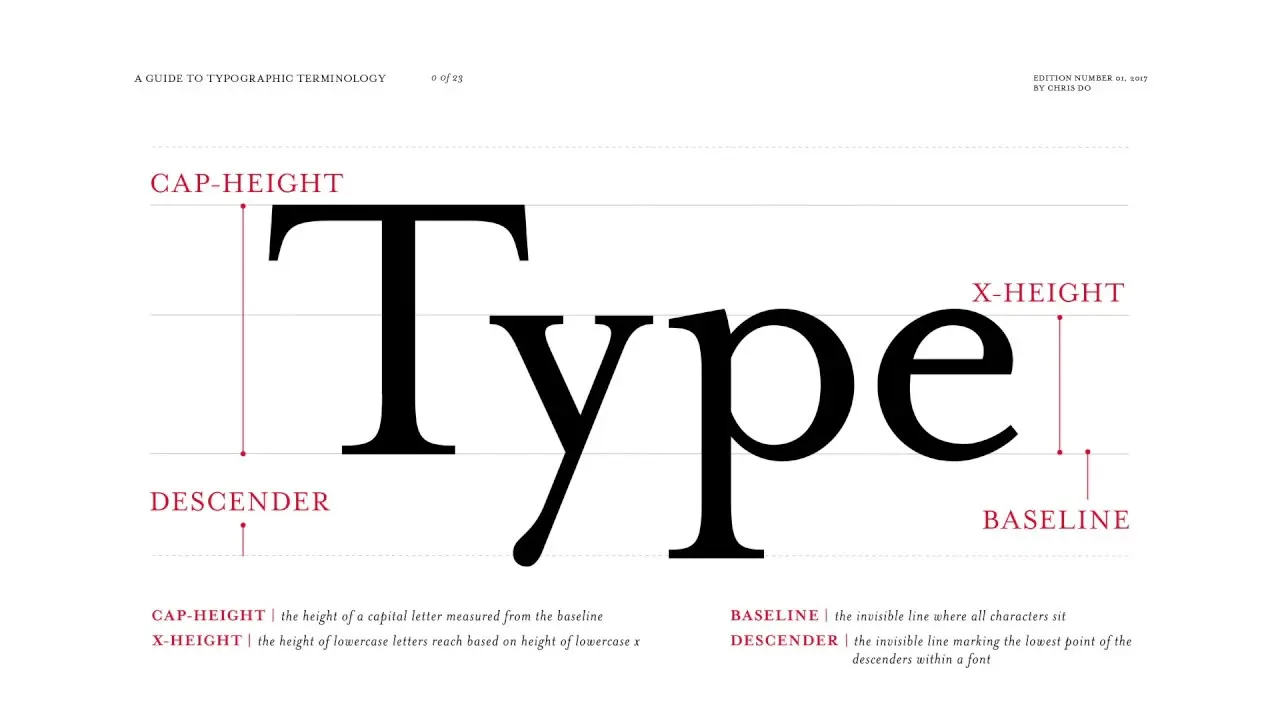
An upward vertical stroke found on lowercase letters that extends above the typeface’s x-height.
The invisible line where letters sit.
A curved stroke that encloses a letter’s counter.
Fully or partially enclosed space within a letter.
A horizontal stroke.
A downward vertical stroke found on lowercase letters that extends below the baseline.
An angled stroke.
A small stroke projecting from the upper right bowl of some lowercase g’s.
A tapered or curved end.
The thin strokes of a serif typeface.
Two or more letters are joined together to form one glyph.
A stroke that connects the top and bottom bowls of lowercase double-story g’s.
The enclosed or partially enclosed counter below the baseline of a double-story g.
The smaller form of letters in a typeface.
“Feet” or non-structural details at the ends of some strokes.
A curved stroke originating from a stem.
Uppercase characters that appear as a smaller size than the capital height of a typeface. Short for “small capitals”.
The main curved stroke for a capital and lowercase s.
A small projection from a curved stroke.
Primary vertical stroke.
A descending stroke, often decorative.
The end of a stroke that lacks a serif.
A letter or group of letters of the size and form generally used to begin sentences and proper nouns. Also known as “capital letters”.
The height of the main body of a lowercase letter.
The terminal (end) of an instroke or outstroke is often a serif or a stroke ending. A seriffed terminal may be described as a wedge, bulbous, teardrop, slab, etc., depending on the design of the type. Typefaces may be classified by their look, of which the weight and serif style – whether serif or sans-serif – are key features. Some designs also have spurs, which are smaller than serifs and appear on angles rather than at a terminal, as on e or G.
More info: eCommerce Strategien von milo 3oneseven 3oneseven Auszeichnungen Style Guide Effectively optimize Shopify GEO + SEOAnswers to help you understand how work, collaboration, and results get delivered.
Delivering tailored ecommerce solutions including custom apps, conversion optimization, and full ecommerce store design and development
aimed at boosting ecommerce functionality, optimized user experience, and high-converting ROI for online businesses.
Get to know services.
It starts with a project definition to understand your vision. Then setting the site structure, design and devlopment,
and refine them based on your feedback. Once the previous workflow is approved, the launch process is initiated.
View process.
Most projects are delivered in 4 to 8 weeks, however large migration projects tend to last up to 3 months.
View migration service.
Featuring a five-star track record in the design, setup & optimization of ecommerce stores.
With over 500+ successfully launched ecommerce stores, milo 3oneseven offers end-to-end services in Shopify store design and development, including store migration (woo, Magento etc)
Meet milo.
Yes, providing full scale maintenance and growth plans for different areas with various packages tailored to your needs & expectations.
View all services.
Understanding the anatomy of typefaces is essential for designers and typographers. View article at Anatomy of a Typeface Character